Blog

  • Red Phantom

    This is my first science fiction story to be published. I’m experimenting with writing away from my usual themes… hope you enjoy. –Rahul

    Maxwell bundled himself clumsily into the Habitat’s airlock. A pneumatic sensor triggered a sharp hiss that shunted the fine Martian dust from his white suit. He’d been called in early from the day’s research assignment on a count of the impending storm.

    We had made contact with this planet three months ago. In that short time, we had learnt much about Mars – a planet that had been an enigma to our species ever since we turned our eyes to the stars. Now, with only a few weeks to go before they sent in the next crew, we were wrapping up our mission. We’d leave the station shortly before the new guys arrived, making space in the Habitat for more explorers.

    “We’re in for one helluva treat this evening,” exclaimed Maxwell, as he made his way into the kitchenette. “Winds’re gettin’ crazy out there!”

    There were three of us – the three pioneers, as they hailed us back home. Maxwell, the geologist. Kirby, the mission engineer. And myself, science officer. We shared an equal passion for the Cosmos, and I guess it was that — along with our impressive flight log — that got us the job in the hot seat. The first humanoids on another planet. Gazing up at the twilight pink sky, that tiny disc of a star slowing its onslaught of rays onto this barren, strange land, it was easy to feel our place within this grand architecture. The Earth had been invisible to us for three months. And whilst the excitement of what we were doing fuelled us, there was an unspoken truth that hung in the artificial air within Habitat-1 on the Olympus Mons basin: we longed for that pale blue dot, perhaps more intensely than the countless others before us had longed for this red riddle.

    “Mission Control, this is Habitat-1…” Kirby’s voice droned into the microphone from the pilot deck. A spurt of static followed a sharp acknowledgement from back home. “We’re turning in for the night. Bad storm on its way…”

    “We read you, H-1,” came the terse reply. The planet would be turning away from Earth, and we’d enter a brief dead zone. The Martian night was impending. Out here, this far away from the Sun, the nights were quite a sight: a black sky, peppered with a million burning fires from lightyears away, with the twins Phobos and Deimoes radiating their soft luminescence upon the orange powder that covered this planet.

    Silence permeated the Habitat’s cabin. Outside, a Martian storm was broiling. We could hear the winds gather speed. It was an awesome phenomenon, experiencing such a storm on a distant world. It was, truly, alien.

    Kirby powered-down the systems. A soft hum sounded from the computer bank. Fingers dancing across a keyboard, he gently eased the machine into sleep.

    It was then that I felt it: a chill that began to sweep through the living quarter. Kirby and Maxwell felt it too: we looked, alarmed, at each other. This was not normal.

    And then it began. That haunting mechanical sound that cements fear: a low, pulsing drone from the emergency console. The entire living system was bathed in a red glow. Kirby dashed to the mainframe monitor. Maxwell and I ran over to the radio. Of course, there was only static. We could only contact the return vehicle, orbiting miles overhead. It was useless.

    “CO2 tank is down,” cried Kirby. “Pressure leak in 2-7!”

    His words hung in the air. 2-7 was a tank array fixed to the outer hull of the Habitat. The only way to reach it would be to go outside.

    “Can’t we remote-shutdown?” I yelled over the sound.

    Kirby rapped at the computer’s keys. He squinted at the display.

    “No,” he replied. He looked worriedly over at us. Mission Control couldn’t contact us – we were in a zone of radio silence. Our orbiting craft overhead was programmed on a flight path that meant it was impossible to stage an evac any time soon. There was only one thing we could do.

    I rushed over to the rack of EVA suits. A mutual understanding was had, I knew that. I was the only one who knew how to disarm the faulty gas tank. Because I’d designed it.

    Kirby and Maxwell rushed over to the EVA control deck. We all knew we had mere minutes to sort this out; the impending storm was moments away. And trust me, you did not want to be caught in the middle of a Martian dust devil.

    I stepped into the airlock. A cloud of vapour descended over me. Then that hiss. The circular door slid open, revealing the icy Martian night. The wind bit at my suit, scattering the white material with that distinct, fine orange powder.

    Habitat-1 was designed as a hybrid living system/rover. There’s these huge trawler wheels, almost like the metal treads of those old fighter tanks – but on a grander scale. Stepping out onto the red soil, I moved carefully past one of these giant wheelbases. The tank array was located underneath the structure; there was just enough room for one EVA walker to squeeze into the narrow space between the rocky surface and smooth engineering of the undercarriage.

    A squawk of static broke the silence inside my helmet. It was Maxwell. He told me that the leak was spreading to the second of the four tanks. I needed to act fast. Wrenching my body, trapped in the heavy EVA suit, I eventually managed to see the complex array system.

    What perplexed me was the reason for this leak. What could possibly have caused it? We had based ourselves on what we knew was a safe area. There was no threat to tectonic activity. Maxwell’s geological findings hadn’t revealed anything peculiar about the underground. And it couldn’t have been the inducing of the sleep mode from inside. We were doing that for the past three months; the entire system was designed for it. A chilling realisation crept through my mind. It was the only explanation. There could be no other reason: something external had compromised our life support.

    I reached the array. The central tank had a horrible scar through the middle. Thick vapour flowed like tendrils of liquid through the iced atmosphere. But what caught my eye was a striking affirmation of my fears.

    Emerging like a sword stabbed through a man’s heart from the tank, was a thin, metallic plate. In the shallow light from my helmet, I could vaguely discern an intricate and complex pattern embossed on its surfaces. No humanoid could ever have designed that. It was distinctly foreign from us.

    My breath caught. A deafening silence pressed down on my head from within the helmet. A single thought wracked my brain: how could we have missed this? We had been living on this rock for three months. How could this discovery have eluded us?

    And somehow I understood. Glancing over my shoulder, I noticed something I had overlooked earlier — just after I had departed Habitat-1. This was no ordinary Martian tempest: the zephyr carried along its invisible currents metallic flakes. Stepping out from the cramped array, I walked a few paces away from the craft. I ignored Maxwell and Kirby’s shouts of danger; my attention was focussed on the new enigma that this planet now presented. No orbiting satellite, no mechanical explorer before us, could’ve discerned what I was observing that night.

    Snowflakes. Metal snowflakes. Differing in size, some as tiny as a hair follicle, others about the approximate size of a small stone. I reached out into the wind, and captured one in my gloved fist. Examining the object through my visor I immediately recognised those peculiar markings etched on its smooth surface.

    Something didn’t feel right about all this. The different sizes. The fragmented pieces… as if… as if broken-off from something larger. A fractal of sorts… The single word rushed like a projectile through my mind:

    Debris.

    Somewhere out there, in the distant Martian horizon, another craft had just crashed into the rocky surface. Looking through the billowing clouds of dust whirling before me, I could vaguely make out the outline of a ghost. A red phantom. A craft that was strikingly inhuman.

    I moved quickly. Retreating to the array system, not saying a single word to neither Kirby, nor Maxwell, I carefully removed the metallic object that had pierced our CO2 tank. Then I shut-down the cylinder, and carefully removed it from the rest of the system. We were safe… for the while. Finally, I radioed to the others. It was time for an unplanned EVA.

    *

    It took us about thirty minutes to traverse through the Martian winds. We used the buggy, a small rover that was designed to carry our research assignments to the farther reaches of our exploration radius.

    Our first reaction to what we saw was that this was certainly not human engineering. The fallen vehicle wasn’t of the usual capsule-like shape of our Earth-crafted space machines. This looked incredibly advanced. Angular, with materials we had never seen before, much less utilised for spacecraft.

    I was the first to approach the craft. Even through the broiling winds I could easily see the extent of its damage. I could almost imagine its final moments of flight; drifting light light through the interstellar vacuum, from a distant home, perhaps it had lost control, and forced by the Martian gravity, had slammed into the red planet.

    As Maxwell and Kirby joined me in standing before the behemoth of this alien spaceship, a current of excitement surged through my veins. Transient beings, no matter how far dispersed across the stars, held that same desire to explore, to make contact, to feel bound across the firmament. We knew not, at that moment, who or what lay within the fallen spacecraft. But in the vastness of our Cosmos, for the first time, we knew we were not alone, the only inquisitive creatures on a pale blue dot floating in the darkness of space.

    ©2011 Rahul Dowlath. All rights reserved.

  • On Writing for Bloggers

    I’ve been blogging for a reasonable amount of time now. It started on a whim back in early 2007 when I signed up for a Blogger (.blogspot) blog. After discovering WordPress, my blogging has soared, and I’ve written (at least, I think) a diverse range of posts.

    So I’d like to give back to the blogosphere, so to speak. This post will include some tips on writing for blogs. Now you may wonder: why should it be any different to writing for other mediums? Well, writing is an intricate art. And as with all art, it can only be successful if expressed correctly, be it through tone, style or diction, within the context of the medium of work.

    Blogs are a fast, dynamic format. You need to be able to express yourself concisely. Sure, lengthy exposition posts are sometimes welcome – but you need to be attuned to your reader. And most purveyors of blogs tend to read on a short time span, perhaps as a means to pass commute time, or within the confines of a lunchtime break. So I’ll try and be succinct on my tips in this post. Here it goes:

    • Your article needs to transport the reader from their mundane daily existence.
    • Inform the reader. Give them something that they can take with them from your post. Present new knowledge in the form of thought-provoking opinions, or news.
    • Have some wit. It adds colour to the article, and will captivate the reader. Try not to be dull.
    • Instigate discussion, and engage with your readership. It’ll ensure the longevity of your blog.
    • Write like you mean it. You’re blessed with the ability to be literate. It truly is a gift; now use it. Don’t abuse this beautiful language of ours. By using correct grammar, diction, tone and writing stylishly, you’re showing your audience that you care about your work. Your passion will exude through the words on the screen. It’ll bring them to life. The design of your blog includes every aspect: the layout, the colour, the theme, even the content. Respect your blog’s style, and write with purpose. Write correctly. Nobody – at least, no discerning reader – wants to read posts that are poorly constructed.

    Writing is fun. Writing adds joy to our life. Writing elevates us from the banality of our daily existence, and takes us to new frontiers. Now go forth and blog, my friends, and let the world know what you think of it!


  • The Echo Chamber

    The following is a post written for my school’s student blog. In light of my departure as editor of the blog, I thought it’d be fitting to publish this particular article here at Life in Pixels: a message, of sorts, to the next leaders of that blog, of the challenges they face in this new age of journalism the world is experiencing. Read the original post here.


    "…there is a feeling of injustice being committed when we see our writing reproduced in the guise of others."

    These are dangerous times that we live in, my friends. The Age of the Internet may be the magic we’ve sought after for aeons, that one thread of binary that keeps us connected across oceans, but there’s a darker, more sinister side to it. George Orwell accurately described the consequence of our age, transcending from a utopian to a dystopian future, in his harrowing and age-defining novel Nineteen Eighty-Four. The all-prevailing “Big Brother” has full control over the masses, and can manipulate their thoughts and ideas, effectively their entire belief systems, entirely through the effective use of media.

    As budding journalists for a new magazine, we as the Editorial Team of The Echo have a great responsibility on our hands, as informers to you, the student body, of the happenings in and around our campus. Our opinions, our ideas, the words that we write, have in some way an influence upon you – just as the modern media in the “world out there” has enormous control over the public.

    In the rapid world of modern journalism – controlled largely by the high velocity of the Social Web – authenticity is the all-encompassing goal. That goal is the core value that we strive for in the content we publish. Our fundamental aim as writers in this new age is to ensure a level of quality, original content that differentiates us from the masses, most of whom find it blasé to regurgitate that which has already been written by others.

    The scourge of plagiarism in today’s Social Web-era is more prevalent than ever. For us, writers that are concerned with producing quality, original content, there is a feeling of injustice being committed when we see our writing reproduced in the guise of others. Perhaps this all whittles down to the nucleus of the problem: the sense of integrity that seems to be a commodity in this fast world. Content that is rehashed can now be argued as being “syndicated” in a sense.

    At the end of the day, it is the reader who is left in the void of uncertainty, and it is the word thief who has committed the greatest crime of information-sharing. It is now not the original writer who has the responsibility of discernment: the copied words, placed in different context, have the power to influence the public in a manner unintended for by the original creator. Thus, the role of Big Brother is distorted, and in the broader scope of the digital age, an enormity of unprecedented proportions has the potential to envelop our world.

    As young writers, we have quite a task on our hands. But we stand strong in the pillars of integrity that bind this blog, and the content on it, and I am confident that it is this defining attribute that will manifest us as crafters of a new age in journalism.


  • Wise Words from a Legendary Architect

    Architect Frank O. Gehry is no stranger to innovation. His non-conformist approach to architecture has reshaped our urban horizons, providing new perspective to the understanding of structures as not merely systems within which we seek protection, but rather, also as self-contained works of art.

    But to attain this legendary status within the architectural sphere of human civilisation, Gehry has had to confront significant resistance to his bold proposals of new ideas. In this short video, he proffers two simple words that sum-up what the brave spirit of modern innovation should harbour when setting out to change the world:

    Be yourself.


    To get an idea of how bold Mr Gehry is in his work, here is the Walt Disney Concert Hall in Los Angeles, designed by Gehry Partners, LLP.


  • Where to next…?

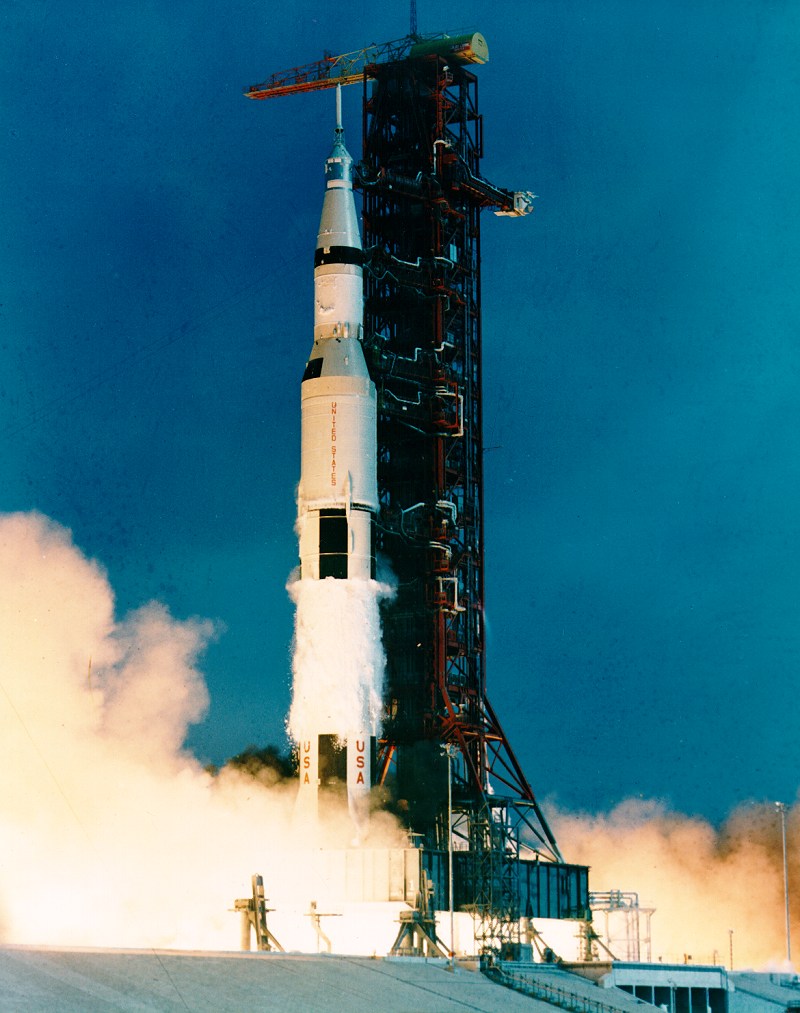
    The azure sky beckoned to them as they sat, perched precariously at the zenith of a machine that rendered, in its very bolts and metal, the dreams of not just an entire nation, but all of mankind. The tinny voice scrambled and squawked into their headsets. Numbers counting down. A low sound rumbled in the beast’s loins as the liquid oxygen engines roared into being. The cramped capsule began to shudder. A seagull, oblivious to such a momentous hour in man’s journey on this Planet, tumbled off the tower in a flurry of feathers. A second later, a single number was called out – “ZERO!” – and the progress of our discovery, the defining mark on this epoch of our great existence, was mapped out in the smoky trail of the Saturn V’s boosters.

    Apollo 11 – with its spidery Eagle, and Columbia, carrying her precious cargo – set a blazing trail that was the epitome of mankind’s tenacity to go beyond.

    Ask any of my old-time friends, and they’ll tell you of my avid fascination with space travel. The Cosmos holds a special place in my heart; there’s something inherently intricate in the design of our Universe, and our forays into trying to understand this ancient architecture through our space programmes deeply intrigues me.

    Recently, I’ve rekindled this spark of interest upon watching a brilliant documentary on BBC Knowledge. It’s called The Space Age: NASA’s Story. Using never-before-seen, original, re-mastered footage, the tale of how one of the world’s most powerful space agencies is weaved, with interviews from the legends of space travel.

    Watching what space travel was, what it stood for, in the 50s and 60s, got me thinking about where we stand today. In the forty years that followed that momentous first step on the moon, our technology has improved significantly. Yet here we stand, at the precipice of a new era in discovery of our Cosmos, with a retired shuttle fleet, a cancelled continuation project (Constellation), and the continuing privatisation of space.

    We desperately need innovators. We need people with the same tenacity as those Soviets and Americans who pioneered space travel, pushing the boundaries of our civilisation.

    But we also need a keen, holistic enthusiasm from the people of this planet.

    The Space Age: NASA’s Story aptly captures the excitement that human spaceflight created. There was indeed a sense of awe that prevailed through those years of the Mercury, Gemini and Apollo programmes. Has space become an expected norm today? Has the continuous ferrying to-and-from the International Space Station created a sense of routine? Perhaps.

    But maybe it’s the other frontiers that have risen as the race for space died. Kennedy’s charged words are a reminder of that by-gone era when sending a man into space, and onto a distant, heavenly body that captured mankind’s soul for centuries, held an entire planet captivated:

    “We set sail on this new sea because there is new knowledge to be gained, and new rights to be won, and they must be won and used for the progress of all people. […]

    We choose to go to the moon. We choose to go to the moon in this decade and do the other things, not because they are easy, but because they are hard, because that goal will serve to organize and measure the best of our energies and skills, because that challenge is one that we are willing to accept, one we are unwilling to postpone, and one which we intend to win, and the others, too.

    –President John F. Kennedy, “Rice University Speech” (1962)

    In our age, we have the technologies. We have the knowledge. We have the abilities to “do the other things” in science and technology that will push the human race forward. But what we require is the drive, the will to innovate; a delicate membrane that exists between the dream and the realisation, forever threatened to be swayed by the motions of bureaucracy.

    A new era of discovery awaits a new generation. We now face the charge of respecting the path foraged by those that came before us, and plunging into the unknown depths of our Cosmos.