Blog

  • Welcome to another new year

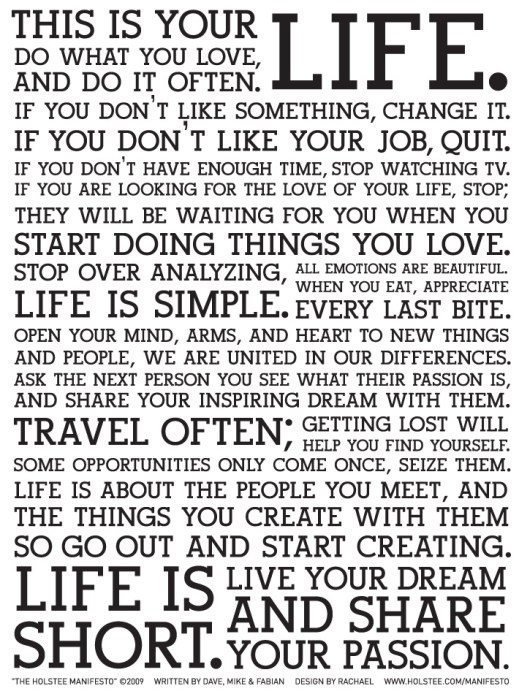
    It’s already 2013. To kick-off the new year and the possibilities that it embodies, here’s a brilliant manifesto I stumbled upon at a great blog called Brain Pickings. Visit that site for an eclectic blend of inspiring connected ideas. I hope this manifesto gives you the inspiration and energy to fulfill the dreams and aspirations you have for the year. Happy new year, and I wish you the very best for 2013.

    holsteemanifesto


  • Why I Choose WordPress for Blogging

    I’ve been blogging for a long time now. One of the things I’m asked often by aspiring bloggers and website owners is “which platform should I choose?”

    We’re certainly spoilt for choice today when it comes to starting a blog. There’s a multitude of platforms to choose from, and it can be quite daunting. So I’m going to attempt to tell you why I swear by WordPress for my blogging adventures.

    1: Platform connectedness. WordPress takes care of optimising my blog for all devices – mobile and desktop. I can just focus on the content, and WordPress will handle the look of Pixelated Thinking  on iPad, iPhone, Android and the plethora of other web browsers out there. And it looks pretty good too.

    2: Blog from anywhere. Whilst I do use Evernote to draft posts sometimes, there’s no denying that the native WordPress app for BlackBerry and iOS is excellent. It allows me to monitor site stats, reply to comments. Oh, and even write entire posts if the inspiration strikes me when I’m out and about. Like all other things WordPress, it looks beautiful too.

    3: Themes. WordPress has some awesome themes. There’s a lot to choose from (which can lead to massive procrastination), and the themes look trés professional. They just convey the feel of a stable, content-rich blog. I find Blogger (Google’s answer to WordPress and the platform I started out with back in 2007) to be a bit less to my taste; they have, however, improved their design and functionality of blogs. But I’ll still stick to WordPress thanks.

    Lastly, Akismet spam protection is one of the best features. It protects my blog from the bombardment of spam comments.

    If you’re considering going out into the blogging world, I truly recommend giving WordPress a try. If it’s good enough for the professionals (GigaOM, TIME), then I’m sure it’ll be perfect for you.


  • So, here’s the problem with doomsdays

    Well, they’re utter bulls**t, of course. But there’s more. Obviously. See, the thing is, the world today is more connected than ever before. And this means that learning has become something that extends beyond the classroom. To survive intellectually in this age, one needs to adopt a sense of skeptical thinking. A scientific way of approaching things. A measured, calm, analytical mindset.

    Unfortunately, this way of thinking critically is only possessed by a select faction of society. And that’s where the mass-hysteria surrounding pseudoscientific beliefs like the 2012 apocalypse proliferate. And we don’t have to look farther than our beloved World Wide Web to note that ideas catch on faster than wildfires.

    Skeptical thinking doesn’t mean the rejection of all ideas. No. It means listening to all ideas (good or bad), and then assessing them critically, considering the validity of them, sometimes testing them scientifically or using logical thinking or accepted theories to determine whether said ideas are plausible.

    It’s a refreshing change from submitting oneself to the hysteria surrounding claims that, for instance, there will be a magnetic shift of the Earth’s poles, or that some (fictional) planet called Nibiru will collide into us.

    It’s very easy to succumb the mind to these claims. After all, it’s a lot more exciting than accepting the scientific approach (advocated by people like NASA, that December 21st will be just as ordinary as any other day). It allows one to feel like they’ll soon be living in some outlandish Hollywood film (I’m looking at you, 2012).

    Technological streams such as Web 2.0 services (Twitter, Facebook, social networks and chat platforms) allow the more paranoid of our species to propagate irrationality. Sometimes I think theses guys thrive on the panic. It’s like some kind of weird mystical energy… jokes.

    For us logical beings, December 21st is probably going to be just as hellish as the Mayans supposedly predicted. The Facebook updates, Tweets and BBM broadcasts are going to reach a frenzy. But when the storm passes over, when the day ends and December 22nd dawns, we shall once again be able to breathe as the tin foiled folk emerge from their bunkers to a world just as unchanged as when they’d retreated. Problem is, though: they’ll be fueled and ready to go for the next bout of doomsday predictions.

    So please, I urge you: adopt the scientific way of thinking, and tell your friends about it too. It doesn’t bite (or cause any apocalypses…). I promise.


  • Oblivion

    Every so often, one comes across a book that is truly worthwhile. That leaves you with a feeling of fulfillment upon completion. There are only a few of these kinds of books that I’ve experienced, and Anthony Horowitz’s finale to the chilling Power of Five series, Oblivion, was part of that select group.

    It is dark. It is depressing. It is horrifying  And at the same time, it is filled with hope: there is no doubt that the entire series is written, in a way, as an allegory of hope for the future, and of the next generation’s responsibility to protect our future.

    Narrative-wise, it is lengthy. At 668 pages, it’s a hefty read, but an enjoyable one. I feel that in places, it could’ve been shorter. There were parts that got agonizingly slow, but they were made up for by the copious edge-of-your-seat action sequences.

    The story is a good continuation from the previous four books, but it is able to stand out as a tale of its own. Horowitz manages to easily integrate retellings of previous events, easing readers into this much-anticipated conclusion.

    The conclusion itself is quite worth it. Without wanting to give away details, it has some unsuspecting surprises, and some obvious takes that were clearly being built-up in the final parts.

    The very final bit, the epilogue (or “Envoi”) was a nice touch. But it is clear that this series is over, and it has been a great ride throughout. If you’re a fan of Anthony Horowitz’s writing, and a long-time investor in the series, this is definitely a must-read for you.

    Horowitz is expected to return to the Alex Rider universe next, with the standalone novel tentatively titled Yassen.


  • James Bond is Not a Spy

    This quote extracted from the introduction to Vintage Classics’ 2012 reprint of Casino Royale, written by Alan Judd:

    That is why Bond is not – contrary to popular imagination – really a spy. As a rule, he doesn’t discover intelligence and report back or recruit agents to ferret out secrets for him. He conducts assassinations (something not done by British intelligence agencies in peacetime), acts as a saboteur or, as in Casino Royale, seeks the downfall and death of an enemy. He is a high-profile operator, a licensed hit-man whose approach may be clandestine but whose operations become very public.