
Blog

  • Dawn of the Age of Spectacular Performance Capture

    RavP8uSbC0Ux
    Good science fiction stories offer one an opportunity to escape to fantastical worlds. Great science fiction goes a step further: it brings up philosophical issues, questions human nature and societal constructs. Dawn of the Planet of the Apes certainly falls into the latter category. It is a film deserving of the “blockbuster” status because it not only has a deeply compelling narrative, but immerses audiences in captivating performances, breathtaking scenery and masterful use of new cinematic technologies to bring a screenplay that’s rich with layered meanings to life.

    I haven’t watched the original “Planet of the Apes” films, so my review won’t be comparative. Instead, I approached this film as a continuation of “Rise”, and as one of the tentpole action films of mid-2014. “Dawn” is so good that I actually watched it twice – in both 2D and 3D.

    Director Matt Reeves does a sterling job of balancing intense, emotional scenes with Caesar and his brethren of apes, and explosive action sequences between apes and humans. This is the kind of pacing and delivery that so many sci-fi films of late are lacking – here’s hoping this film serves as a guide on how to make a good, well-rounded picture. Ape society, led by Caesar and now thriving 10 years after the events of “Rise”, comes across as a sort of parallel to (early) human society – one that is built on the foundations of fear-induced leadership to some extent. This becomes increasingly apparent as the film progresses and one of the two primary villains, Koba, wins over the apes. Parallels can again be drawn between Caesar and his son, Blue Eyes, and Malcolm and his son – this suggestion of similarity between both species brings heart to the story and adds an appreciated dimension to both Caesar and Malcolm, the two protagonists of their respective species.

    The villains of “Dawn” are well crafted. We can empathise with both Dreyfus (the human villain played by the always brilliant Gary Oldman) and Koba (the rogue ape that turns on Caesar). This is a mark of good screenwriting:  both ape and human villains have justifiable reasons for their respective actions, and if one were in their place, one could indeed see themselves acting similarly. Both parties are operating inherently on fear, and on trying to preserve their respective species. This is where the philosophical implications arise: can two dominant, intelligent species co-exist? This is explored to an extent, but along with the entire plot, sets up the answer to be determined in the planned sequel to be directed by Reeves with a release in July 2016.

    Now, intrinsic to the sci-fi genre is the use of high-end cinematic technology to create such immersive experiences. And in “Dawn”, the true star is the spectacular use of performance capture. Watch the video below to see how not only body motion, but intricate facial expressions were captured and superimposed onto the ape CG models.

    Andy Serkis is a veritable legend when it comes to performance capture, cementing his role as the leader in this realm with his breakout role as Gollum in Peter Jackson’s Lord of the Rings trilogy. In “Dawn”, he brings Caesar to life, creating the most compelling digital character I’ve ever seen. Watching this film in 3D with Dolby Atmos sound is an experience unlike any other; the Atmos soundscape draws you in to the auditory world, and the 3D used in this film is some of the best in an otherwise contentious aspect of modern blockbuster cinema. It felt like I was right there next to Caesar and Malcolm, right there in dystopian San Francisco witnessing the battle for the fittest species.

    Michael Giacchino adds to the film’s overall impression with a great musical score that is equal parts nostalgic – the high notes of energetic flutes mixed with thunderous brass and strings, and powerful timpani – and dynamic, creating a strong soundscape that accentuates the drama unfolding onscreen.

    The future of this rebooted Apes franchise should, in my opinion, be the arc of Caesar – thus, there should be a new human cast in the next film, so that we see how Caesar’s interactions with various humans affects his judgement as the battle for the Planet of the Apes reaches its high point. Having said that, it would still be nice to have James Franco return, at least briefly, and meet Caesar. That would be another poignant ape/human interaction that would add immense tension to the impending battle.

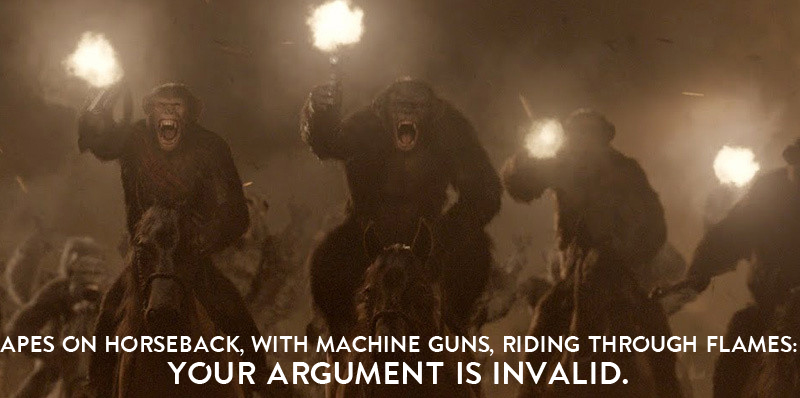
    Should you see this movie? Well, let me put it this way: apes on horseback, with machine guns, riding through flames. Your argument is invalid. Go and see this. Now.


  • Timeless Wisdom from Carl Sagan

    Human history can be viewed as a slowly dawning awareness that we are members of a larger group. Initially our loyalties were to ourselves and our immediate family, next, to bands of wandering hunter-gatherers, then to tribes, small settlements, city-states, nations. We have broadened the circle of those we love. We have now organized what are modestly described as super-powers, which include groups of people from divergent ethnic and cultural backgrounds working in some sense together — surely a humanizing and character building experience. If we are to survive, our loyalties must be broadened further, to include the whole human community, the entire planet Earth. Many of those who run the nations will find this idea unpleasant. They will fear the loss of power. We will hear much about treason and disloyalty. Rich nation-states will have to share their wealth with poor ones. But the choice, as H. G. Wells once said in a different context, is clearly the universe or nothing.

    And also:

    Every one of us is, in the cosmic perspective, precious. If a human disagrees with you, let him live. In a hundred billion galaxies, you will not find another.

    As long as unnecessary violence persists, can we truly call ourselves an evolved, intelligent species?


  • #AmWriting: 10 Soundtracks to Write To

    I’m currently working on a mammoth project – a (possible) 70 000+ word manuscript for an action/thriller novel that I’ve been planning for a few months now. It’s a scary thing to think about, and so writers often need something to help get them through the process. F. Scott Fitzgerald had his (ahem) indulgences, as did many other writers including Oscar Wilde, who even imbued his famous character Dorian Gray with some of his own habits. For me, well, there’s music.

    Music is the perfect mood creator. It helps to set the imaginative landscape and gives the writer much-needed energy to put down words. And with a good pair of headphones and the right music, you can really create a cocoon for creativity.

    I’ve written on the subject of film soundtracks before, and in this post I’ll highlight my favourite pieces to listen to while writing such monstrous things like a first draft manuscript.

    Film and game music are designed to keep audiences engaged with visual content. And since, as writers, we’re creating visual scenes through the magic of words, these two mediums work beautifully with each other. Below are some of my favourite scores to listen to while writing.

    I should mention that, while I present these pieces in the context of writing, they’re suited to most creative tasks where a little mood music can go a long way.

    1. Man of Steel (Hans Zimmer)

    The soaring orchestrations and endlessness of the guitars set a beautiful sonic landscape for your words to flow. The deluxe edition has a brilliant “sketches” session, where Zimmer explores in a continuous mix the various ideas and themes that permeate the Superman reboot.

    2. Oblivion (M83)

    M83 created an electronic-infused score to this Tom Cruise science fiction blockbuster. It’s very atmospheric with lots of rising strings and melodies that almost urge you onward to the next word, the next paragraph, scene or chapter. It’s an especially nice listen when you’re wanting for inspiration, at the beginning of a writing session, and gives your imagination a nice kick start.

    3. Assassin’s Creed: Revelations (Jesper Kyd)

    This is a soundtrack designed to help you focus. Since it’s scored for the (insanely cool) Assassin’s Creed games, it works really well when writing scenes of intrigue, action, or contemplation. I sometimes listen to this to get into the writing mood.

    4. The Dark Knight Rises (Hans Zimmer/James Newton Howard)

    In case you don’t know by now, I’m a huge fan of Hans Zimmer. He’s my go-to guy for a musical fix when I’m working on a creative project. The Dark Knight Rise score is powerful, with great highs and lows perfect for almost any kind of scene. And if you just want to feel inspired, the rousing chant from the movie certainly does the trick, as does Junkie XL’s remix “Bombers over Ibiza”.

    5. Lord of the Rings: The Fellowship of the Ring (Howard Shore)

    You can never go wrong with Lord of the Rings. The quintessential high-fantasy drama, its soundtrack is powerful, rousing, and the perfect mix for creating an immersive creative environment. The final tracks, with Enya’s ethereal voice singing in Elvish, is hauntingly beautiful.

    6. Game of Thrones: Seasons 1-4 (Ramin Djawadi)

    Since I’ve gotten into the Game of Thrones world, I’ve become enchanted by its music. Ramin Djawadi scores a diverse soundtrack that’s a mixture of exotic eastern strings, thunderous trumpets and some chilling lyrics like Sigur Ros’s “Rains of Castamere.”

    7. Skyfall (Thomas Newman)

    Skyfall is one of my favourite new Bond movies, and Newman’s score is a mix of electronic and classical, that’s perfect for action scenes and scenes that are particularly dialogue-heavy. It’s also great to listen to before sessions, to get into that mood (along with Assassin’s Creed and Oblivion).

    8. Da Vinci’s Demons (Bear McCreary)

    Bear McCreary is a genius. The theme for Da Vinici’s is written as a musical palindrome –it’s the same forwards and backwards. The rest of the score is good mood-setting music, in a similar vain to the Assassin’s Creed score mentioned above.

    9. 300: Rise of an Empire (Junkie XL)

    Junkie XL is a rising electonic-based musician, and his score for the latest 300 film is action-packed with definite eastern accents that articulate the sequel’s plot line. “History of Artemisia” is my favourite track on this score.

    10. Inception (Hans Zimmer)

    Where do I begin with Inception? Well, firstly: “Time” is perhaps the best Hans Zimmer piece written. Ever. In fact, watch it in the video below, performed live by Zimmer and his orchestra. It’s emotionally-charged, carefully crafted and powerfully executed. As is the rest of this score, one of my all-time favourite motion picture scores. Its subtle piano notes, contrasted by heavy brass and thunderous drums, create a highly immersive environment that helps one emotionally connect with their work, as with the music itself. It’s Hans Zimmer at his finest.

    (I might write a future post on the status of the above-mentioned manuscript. It’s going as well as can be at this stage and I’m getting closer to the midpoint).


  • The State of the Blog

    The art of blogging has come to define the paradigmatic shift in the web from a content-consumption medium to a dynamic, conversational sphere where ideas can be easily shared and everyone can own their slice of the Internet. Blogs have allowed us to write, share and discuss anything and everything, and their “coolness” factor in the early days of Web 2.0 caused many corporations to adopt them as a quick, informal communication method – a way of bridging the gap between brand and consumer, much like what’s happening in the Twitter world with a multitude of “verified” accounts from brands tweeting as a means of keeping their user bases engaged.

    Newspapers realised in the early days of blogs that print media and their online offerings were struggling to keep pace with emerging blogs, and if you can’t beat ’em, join ’em, right? Which is what they did. However, the actual art form has come under scrutiny for whether it’s a dying medium today. Certainly, with larger print houses there is a sense that readership of content-specific blogs are dwindling, along with technological shifts, that are dictating a move away from blogging and back to more quality-focused content production (rather than the rapid-fire, continuous stream that blogging enables). In other words, content-specific blogging on news sites is not performing as well as other content, perhaps because people are choosing to consume such content from titles that are blog-first (I’m one of those people; I subscribe to numerous blogs and keep up with the world primarily through blogs rather than traditional news outlets).

    I feel that blogging is an inherently personal medium. Whilst its power as a means of communicating in near-real-time with an engaged readership (and thus the ability to strengthen brands) is certainly appealing to companies, blogging has been described as “the unedited voice of a person” (by one of the form’s pioneers, Dave Winer).

    This post is an example of that. I had an idea, after reading Mathew Ingram’s post on GigaOm (one of my personal favourite tech blogs) about this very topic, to discuss, with my personal opinion, the current state of the blog. Thus, this piece is a sort of stream-of-consciousness, my thoughts arranged in bits and transferred to you through the magic of the Internet and WordPress.

    As an “unedited voice”, blogs offer anyone the ability to share their view of the world with the wider audience of the entire Internet. In this manner, I think that blogging will move back to basics, back to its roots as a personal medium. The growth of blogging software like WordPress, and the ease of use of such software in setting up a personal website, coupled with the rise of social media and the App Ecosystem will enable more individuals to express themselves through their own personal homes on the web. Whilst the major publishing houses like the New York Times choose to return to editorial-focused journalism citing content quality as a primary reason, blogging will continue to be the casual, conversational beast that is always has been. And this is the perfect thing that a platform of a personal nature needs.

    So no, the rumours of blogging’s imminent death have been greatly exaggerated. Blogging – at least in a personal capacity – will continue to remain an approachable medium for anyone wanting to share their ideas. It will continue to prove that words and ideas have the power to change the world, allowing thousands of people each day to write, clip, share and re-post thoughts and opinions, making the collective voice of the world that much richer with each press of “Publish.”


  • The DC Television Universe

    Continuing this week’s theme of DC superheros (read this, this and this), today I’d like to talk about the DC Television Universe. Because this coming television season, we’re going to be treated to a plethora of superhero-inspired television – and it’s not just from Marvel. Indeed, Marvel’s Agents of S.H.I.E.L.D. took its sweet time to get its momentum, whilst DC’s offering, in the form of the CW’s Arrow, had a riveting second season with a welcomed mid-season teaser of their upcoming offering, The Flash.

    So what exactly is on offer next season? Along with Arrow season 3, we’ve got Barry Allen’s standalone debut as the Flash in, you guessed it, CW’s The Flash. This show and Arrow will be tightly integrated into what could potentially be a television universe – a rather unique idea considering the current surge in shared arcs for big-budget features by the studios. We’ll get to this later, though. The other offerings are Gotham, an origins tale of sorts for the villains of the Batman world. Incidentally, Bruce Wayne won’t be prominently featured in this series; it’ll revolve around a young Commissioner Gordon and seems like a crime-noir tale, rather than a vigilante/superhero one like Arrow.

    Gotham isn’t going to integrate with Arrow and Flash. It’s a standalone series. But with the tightly-connected arcs of Arrow and Flash, here’s what I’m hoping for: that this is just the beginning of a much wider, richer television universe. One where other DC characters (perhaps minor ones) begin to populate the world. Arrow has proven that DC can make a decent television series with their properties. And with an established fan base for the show, there’s an existing market that would be eager to consume more of this world.

    What’s interesting to see is how these shows react to the emerging DC Cinematic Universe. Will we see Stephen Amell’s Green Arrow join the Justice League alongside Ben Affleck’s Batman and Henry Cavill’s Superman? I, for one, would welcome this. I think it’d be awesome to see these minor JL characters fight the bad guys alongside these superstars.

    We’ll most likely find out how the current television universe fits into what seems like a rather comprehensive cinematic universe from DC, at this month’s San Diego Comic Con.

    Along with The Flash getting his own show, and interacting with the Arrow universe, I’d like to see a Nightwing series adaptation. Arrow, Flash and Nighwing could form a potent triad of heroes that cement the DC flag in a medium fast-outpacing the cinematic facet of the entertainment world.

    Next season will be the reign of the superhero series. Based on how it fares with audiences, we could very well be on the brink of seeing the television landscape becoming saturated with the superhero obsession much like what’s currently happening in film.