Blog

  • Life in Technicolor: “La La Land” Rewrites the Musical Genre

    la-la-land-585c617a5f650

    Contemporary cinema is all about nostalgia these days. But where most films recede into self-referential tedium, along comes a fresh, beautiful little marvel that not only provides an entertaining cinematic experience, but, I think, rewrites the concept of the musical entirely.

    La La Land is the darling of the current awards season, and rightly so. The film has an interesting (if somewhat a bit predictable) storyline, excellent music, and some of the best cinematography I’ve seen in recent years. It is not just a musical love story, but a love letter to the idea of Los Angeles itself: the hope, the dream, the romance and the craziness that is the “city of stars.”

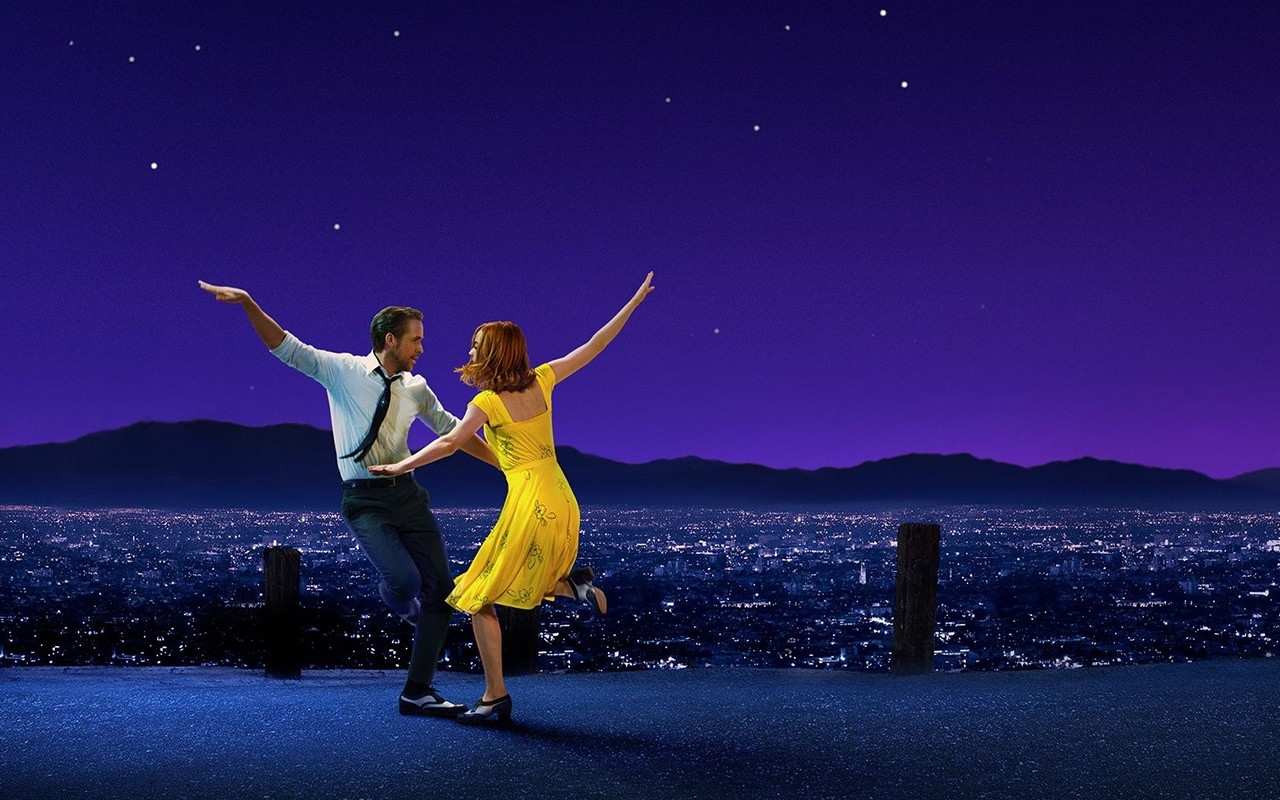
    Approaching the film from a design perspective, this has to be one of the most gorgeously photographed pictures I’ve seen. Linus Sandgren, director of photography, did a knockout job in capturing not just the remarkable colour tone of the film, but setting that against the backdrop of Los Angeles made for a dynamic pairing. The use of primary colours and accents stood out for me in creating the hyper-reality that contributed to the dreamlike narrative. It’s certainly refreshing to see such attention to detail paid to subtle things like colour (especially after watching the washed-out tones of recent DC and Marvel superhero movies). That photo above captures this aptly: the costume designer expertly manipulated the perfect colour tone to complement both characters; the bright colours for Stone’s Mia and the stylish yet subtle hues for Gosling’s Seb perfectly complement each other whilst making the characters pop on-screen; it’s hyper-real cinema at its best.

    The entire picture feels surreal; the breakouts into song and dance, coupled with these vibrant colour tones, truly transport the viewer to this alternate reality. They heighten the sensory experience of the city, and in this exaggeration emphasize the relationships between the characters and magnify an otherwise standard plotline.

    Director Damien Chazelle did a good job in getting sterling performances from the leads. Gosling and Stone have undeniable chemistry (this isn’t their first on-screen pairing), and their voices aren’t that bad either. The songs, composed by Justin Hurwitz, are catchy. I loved the use of jazz as a metaphor for the entire film – being used both literally as a narrative device for Gosling’s character Sebastian, and more abstractly as that moment of magic, that tension and dynamism that is Los Angeles and the romance with this city; the romance that emerges from this city. The refrain that becomes the film’s theme is beautiful; it carries the gravitas of the narrative whilst imbuing a certain nostalgia, a subtle longing for that golden age of cinema (this is how you do nostalgia: with classy subtlety, rather than in-your-face rehashing).

    Here’s that theme:

    That same feeling is conveyed in one of my other favourite numbers, City of Stars:

    John Legend’s character Keith captured it best when he said:

    “How are you gonna be a revolutionary if you’re such a traditionalist? You hold onto the past, but jazz is about the future.”

    In a way this is what La La Land is about: using mechanisms of the past to proffer the idea of a bolder, new cinematic experience: one that uses the traditional tools of cinema (writing, music, cinematography) to create compelling new narratives and entertainment. As much as it is a love letter to the city it’s named after, La La Land is also a homage to Hollywood itself: capturing the frenzy, the absurdity and the magic of showbiz through the perspective of our heroes and their whirlwind romance.

    In a world that’s getting darker each day, it’s refreshing to see a bit of technicolor injected into a movie experience that is true, unabashed escapism. La La Land transports you to a time when cinema meant something: losing yourself in the romance of the magic unfolding on the silver screen, getting catchy (but still good) songs stuck in your head, and reveling in the chaos of Hollywood and its bright colours, all in glorious Cinemascope.

    As Seb says, “I guess I’ll see you in the movies.”

    8/10


  • Going SSD: Breathing new life into a 2012 MacBook Pro

    ssd-drive-iconI’m not the first to extol the virtues of upgrading one’s computer to a Solid-State Disk. But man does it improve your computing experience.

    First, some context: I use my Mac a lot. I constantly push it to keep up with my digital projects that range from simple word processing (like writing this blog and some academic essays for university), to really complex tasks like desktop app development via a virtual machine using C# in Visual Studio, manipulating 3D geometry in ARCHICAD, SketchUp, Rhino and Grasshopper, drafting and graphic design with AutoCAD and Illustrator, and some heavy Photoshop work; even the occasional render with ARCHICAD’s CineRender. Then there’s the side stuff like some motion graphics work and video editing for SKKSA.

    So the kind of tasks this mid-2012 MacBook Pro has handled have been quite diverse. But the machine was showing its age; boot times were extremely slow, ARCHICAD took forever and a day to load-up, and it was generally a very rough experience toward the end-days of the “old” MacBook Pro ride. There was also this annoying bug where stock Apple apps would crash after a few hours (and I think it had something to do with ARCHICAD or its BIM Server component…)

    Without forking out the new Apple tax to get a completely new machine – and my Mac is indeed old enough to justify a full computer upgrade, being in service sine the beginning of 2013 – I’ve managed to extend the longevity of an already solid machine with the upgrade of my RAM earlier this year (to 16GB), and now adding an SSD as the boot drive.

    Here’s the run-down. I found a good deal on an SSD from a local Apple service center in Durban. So earlier this year, on the recommendation of my good friend Bryan, I upgraded the RAM from the stock 8GB to 16GB while I was in Cape Town. According to Bryan, macOS (or OS X, whatever you prefer) loves to be fed more RAM. This OS is RAM hungry, and my first upgrade definitely showed it: I used Activity Monitor to check up on my system, and it was evident that the system wanted to push past the 8GB limit; I was frequently hitting 11GB at times after the upgrade.

    Adding RAM allowed me to do more with my Mac. But adding the SSD… that just made this thing feel like a new beast altogether. SSDs, as you know, read data via flash storage; there’s no spinning platter hard drive that needs to spool-up before you can access data. To give a simple example: it used to take over 2 minutes for my MacBook to fully boot-up and be ready to use; sometimes longer, as the Finder and other media took a long time to initialize. With the new SSD installed, my boot time is 20 seconds – that’s 20 seconds from the time I press the Power key to having a fully ready system waiting for me to give it commands. This kind of speed means a heck of a lot to me, as I spend most of my life on this machine.

    The Setup

    I opted to remove my Superdrive (CD/DVD drive). I reasoned that I hardly use optical media these days. So I moved my existing 750GB hard drive over to that bay, and installed the new 280GB SSD in the original hard disk slot.

    macOS Sierra now boots from the SSD; I’ve got all my apps installed on this drive as well. My documents, iTunes library, pictures and other media are sitting on the old hard drive, which is permanently attached to the system (think of it like an always-connected external hard drive). I used a few Terminal commands to create symlinks (System Links) from the folders on the SSD to their corresponding folders on the HD. This ensures that Time Machine backs up all my data correctly. Having my larger media files on the HD allows me to take advantage of all that space, whilst still having the lean speed of the SSD for booting the system and other apps.

    Going forward I might use the SSD to store ongoing project files for quick access, and then move them over to the HD once those projects are done.

    Going SSD on my Mac was indeed like night and day. I’m still amazed how snappy ARCHICAD is now; AutoCAD is operating like a dream, as are my other creative apps like Photoshop and Illustrator.

    I’m still finalizing a few minor apps, and I need to re-do my Bootcamp partition for Windows 10. But overall the system is functional, and I can’t wait to really put it through its paces as my Mac accompanies me on my Masters of Architecture journey starting next month.


  • Architecture and the Art of Storytelling

    All architecture is a story: every space a paragraph, each detail a sentence. Design is a form of communication – perhaps the most effective, succinct system of conveying abstract ideas into tangible solutions.

    Over the past year, I’ve come to value the importance of the story when engaging in the design process. Developing an idea and following its progression from abstraction to detail can be a daunting undertaking. As architects we are taught various methodologies for overcoming this, various design strategies. One of the most effective, I’ve discovered, is the art of story.

    I’ve always loved writing, and coming up with stories usually through the process of writing them down, rather than explicitly planning everything from scratch before engaging in the creative act. This almost serendipitous act can yield interesting results, and often is a satisfying endeavour. So as I began to engage in the various design tasks of the honours programme, I decided to abstract this storytelling process into an architectural design process.

    By distilling the key findings on-site, and first creating a sort of “knowledge hub” comprising site data, social findings, environmental issues (just to name a few), you begin to create a narrative landscape within which your story can begin to form. I find it important from this very early stage to begin thinking about how the presentation will flow; this may seem counter-intuitive, but it helps to set end-goals and delimits certain aspects in order to progress the workflow. This won’t hinder the explorative nature of conceptual design thinking, but rather enhance it by establishing certain parameters within which to work. And this is not obviously set in stone; this narrative becomes flexible and evolves alongside the design.

    By actually thinking of the design as a story, you begin to perceive the project as a more tangible, dramatic and emotive thing; even though the project may only exist in a virtual sphere or on paper, your story is adding an abstract, emotive layer that breathes a certain life into the thing.

    What this ultimately does is ensure you’re developing a coherent narrative to tell your prospective client about the work you’ve designed. Humans love stories; its something that is ancient and inherent in our evolution. By using the craft of storytelling to guide the design process you’re intricately linking two very potent forms of communication, which can really help sell someone the idea, which is, after all, a key part of our profession.


  • Super (under)powered Cinema

    So I’ll be honest at the start of this: I was a huge fan of superhero films. Browsing Life in Pixels’ archives will testify my adoration of the genre. But recently, I’ve become tired of these films. They’re formulaic (which is sometimes not such a bad thing… but, you know). Netflix does a great job of producing some actual substance in this field, but for the most part the television side of the genre leaves much to be desired.

    I would watch, week in week out, the latest episodes of Arrow, The Flash, Agents of S.H.I.E.L.D., … until it all just got too much. How much of my life was I willing to invest in this? There comes a point where entertainment becomes a chore, and I think I’ve reached that. In its response to mass-consumption, itself a product of the success the genre has felt since the first Iron Man hit theatres, superhero films and television have since departed the gravitas that once underscored the category.

    Now, I’m not saying that I’m a voice with final-say in what people should be watching or consuming. We live in a free(ish) society; we can do what we want. But I’ve since become uninterested in this genre, a part of pop culture that at one time was a powerful critique on society, and that formed a big part of my own life.

    Take Nolan’s Batman films. Yes, I know. It’s a cop-out whenever a critic of contemporary superhero cinema brings out Mr Nolan and his work. But with this succinct trilogy, he crafted a piece of cinema that is both powerful as a work of art, a strong series of examinations on our society – a society that is plagued by fanaticism, crime, terror, rogue ideology and fear. The Batman becomes the lens through which we examine what it means to live in such a world. Tom Hardy’s Bane represents that strong, terrifying faction that can, at any moment, shake the very foundations of our civilisation. Ledger’s Joker, of course, just wants to see the world burn.

    The point is, these films carried substance. Gravitas. And Nolan knew when to stop. He set out to tell this legend, this mythos of the Batman, and he achieved it through those three films.

    Superheroes are, I believe, a potent vehicle for exploring very human issues: politics, race, culture, power… historically, they have been used as a critique on society. But in the commodification of the genre, as Hollywood’s prying fingers tear through the metaphor to mine the cashflow, I fear we’re losing that very essence. Yes, on the print side, things still seem to be alive and kicking. But I’m arguing from the cinematic perspective, and the state of things in that arena leaves much to be desired.


  • A Humanist Approach to Smart Cities

    This is an essay written for the honours-level course “Urban Infrastructure” (APG4021F) offered at the University of Cape Town’s School of Architecture, Planning and Geomatics. The essay was written in 2016. Citations are provided at the bottom of the post. Please contact me should you require further information or re-use info.

    The idea of Smart Cities has permeated global discourse around contemporary city design. However, its core goals of improving the lives of denizens has been obscured as technology companies seek to manipulate the term for marketing purposes. This essay argues for an alternative approach: a human-centric way of re-looking at the idea of the “smart city”, where technology and urban design can work together for the benefit of urban life.

    (more…)