

Blog
-
SpaceX: Boldly Going into the Future
Yesterday, South African-born billionaire entrepreneur, inventor and engineer, and founder of eBay, PayPal and SpaceX, Elon Musk, launched the first private attempt to dock with the International Space Station. This bold move goes down in history as the beginnings of a new frontier in space exploration – the age of private spaceflight.
I’ve been following the private sector’s developments in space technology for some time now. You may be wondering why the big cable news networks and blogs are making such a fuss over the Falcon 9 rocket’s launch. The gist is this: before President Obama came into power, the National Aeronautics and Space Administration (known as NASA to non-space geeks) had this brilliant, yet exceptionally expensive plan for a programme that would take-over from the aging space shuttle fleet (the STS, or space transportation system programme that’s been a large part of NASA’s recent history). It was called the Constellation Programme, and the idea was to return to the moon by around 2017, and from there, move to a human landing on Mars or an asteroid. They’d even begun testing new rocket-engine technology and had developed three concept vehicles based on an engine called the Ares. Things were looking good for NASA, until Obama came into the White House, and, inheriting a poor-administered political landscape and having to begin a term of office in what was probably the worst economic climate since the Great Depression, he effectively cut all funding for the Constellation Programme. Just like that, the excitement at returning to our cosmological neighbor was brought to a standstill.
NASA thus decided to outsource its rocket building activities to the private sector, so that they could focus on astronomical research, and at the same time, give themselves more time to work on a new rocket system that could fulfill at least some of the objectives of the scrapped Constellation programme. SpaceX is one such private company that has shown significant potential in developing and successfully launching a vehicle that, it is expected, by 2014 will be able to allow the United States to launch their own astronauts to the ISS and not rely on their partners at ROSCOSMOS (the Russian Federal Space Agency).
SpaceX has proved that it is possible to engineer a space vehicle at a fraction of the cost of what governmental agencies spend on this type of design work. Yet it also opens up the skies to a myriad number of designers, engineers and future thinkers who are willing and ready to contribute to the advancement of our civilisation, a future that is certainly embedded firmly in the realm of the stars.
-
George Orwell: Why I Write
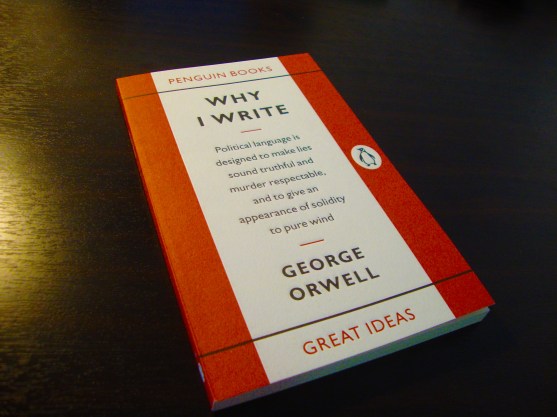
From a very early age, perhaps the age of five or six, I knew that when I grew up I should be a writer. Between the ages of about seventeen and twenty-four I tried to abandon this idea, but I did so with the consciousness that I was outraging my true nature and that sooner or later I should have to settle down and write books.
– George Orwell, Why I Write
Today I found this copy of a collection of essays by Orwell. He’s one of my most favourite writers. I thoroughly enjoyed Nineteen Eighty-Four, and these essays, particularly the main one, Why I Write, is sure to give me further insight into this remarkable man’s motives for writing. Perhaps even some inspiration for my own writerly pursuits.