Life in Pixels

haud ignota loquor

  • The World Has Lost a Visionary

    Here’s to the crazy ones.

    The misfits.

    The rebels.

    The troublemakers.

    The round pegs in the square holes.

    The ones who see things differently.

    They’re not fond of rules.

    And they have no respect for the status quo.

    You can praise them, disagree with them, quote them,

    disbelieve them, glorify or vilify them.

    About the only thing you can’t do is ignore them.

    Because they change things.

    They invent.    They imagine.    They heal.

    They explore.    They create.    They inspire.

    They push the human race forward.

    Maybe they have to be crazy.

    How else can you stare at an empty canvas and see a work of art?
    Or sit in silence and hear a song that’s never been written?
    Or gaze at a red planet and see a laboratory on wheels?

    We make tools for these kinds of people.

    While some see them as the crazy ones,
    we see genius.

    Because the people who are crazy enough to think
    they can change the world, are the ones who do.

    Think Different. Apple.

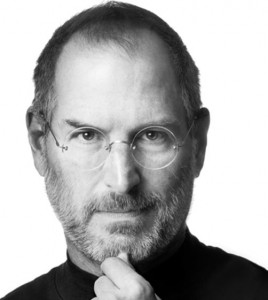
    Today is a dark day for our future. We have lost a visionary. Steven P. Jobs, the pioneer of breakthrough technology, the man who captivated the world with incredible ideas, and showed us that technology is not just about the the hardware or software, but about the experiences between people and their creations, has passed on.

    Steve Jobs is one of my ultimate heroes. He has inspired me, through his work at Apple and his tenacity to think different, to push the boundaries, to innovate, to go beyond and to reach new frontiers. He was a shining beacon in our ever-evolving civilisation. His vision of a connected digital future, the vision that Apple espouses and propagates through their highly successful and industry-changing products, led us into an age where we have come to take the devices we use for granted. He set an incredible standard for perfection in his design, that many competitors have tried so hard to compete with.

    Jobs shook the very fabric of our modern world. He innovated four different industries – personal computing, music, film and post-PC. There are not many human beings on this planet that can attest to a similar record. I don’t have to quote him – his legacy speaks for itself. From its fledgling beginnings in California, Apple has captured the world. Jobs, once fired from the company he co-founded, took Apple to become one of the three most powerful companies in the world – amongst the oil companies and conglomerates.

    His contributions toward the future of our civilisation are immense. He is, and will always remain, a true pioneer of our modern world. A titan who walked amongst us. He pushed the human race forward; he was crazy enough to think that he could change the world, all those years ago in a dusty garage in a Californian suburb. And today, we need not look far to realise that he achieved that. As we are swept once again along the ever-flowing digital river of technology, I believe it imperative that we remember this man’s vision, his contributions to our advancement, and his legacy through his work at Apple and in his personal ethos.

    Farewell Mr Jobs. Your have inspired a new generation of innovators to continue where you left, and in turn carry-out your vision of a bright, stylish and innovative future.


  • Desmond Tutu on SA Government’s Myopia

    This video is a must-watch for any South African citizen out there, and any citizen of this world, for that matter.


  • Thoughts on the iPhone 4S

    Apple yesterday announced the iPhone 4S, the next iteration of the powerful smartphone that inspired the mobile revolution. This is major news for the technological sphere, because after all, when Apple breathes, the world shakes in its wake. The original iPhone left many of its competitors stumbling, and fumbling to provide a significant challenger (of which, to date, I don’t really see anything worthy of taking on this titan).

    As with any Apple product announcement, the iPhone 4S was preceded by months of speculation. Rumours were abound about the possibility of an iPhone 5, and its failure to appear at yesterday’s media unveiling at Apple’s campus in Cupertino, California actually caused the company’s shares to plunge down over 5% – quite contra to what the usual reaction is to Apple announcements. Thousands of fans the world over were left feeling dejected at the seemingly modest update to the iPhone – but they fail to realise that there was no official iPhone 5 to be launched – merely speculation. On the other hand, the iPhone 4S provided many clues to the rumour-mill in the guise of case designs, part leaks and the usual “analyst speculation” and “sources familiar with its development”.

    So while the iPhone 4S looks almost exactly like its predecessor (the iPhone 4), I still believe that it provides a formidable threat to the competition. And the power of that threat is packed largely into a new and exceptionally futuristic tool called Siri. Some are even likening it to the Terminator series. It’s that good. Basically, Siri is an artificial intelligence that you can hold in the palm of your hand. Instead of the archaic and cumbersome speech that we often have to apply to voice-recognition software, Siri takes a natural approach to actually speaking back to you, and understanding natural human commands. Take a look at this video for a better understanding of what this technology can do:

    The crux of the iPhone 4S is certainly Siri. This technology reminds me a lot of the old science fiction stories of artificial intelligence – and what a coincidence that Apple launches it the same year that I did an English presentation on AI technology and the concept of the “Singularity”. Siri will pose a great threat to the competition: coupled with the power of the iPhone 4S’s A5 processor, the technology provides a natural feel to voice-driven navigation of a user interface. And as history has shown us countless times before, Apple excels at providing a product that has all parts – software and hardware – designed and built in-house. Samsung and the cloning competition do not have this advantage – they piggy-back on the Android OS, simply customizing it to fit their hardware, and churning out a new model with a confusing name like SG1245-S* (and usually appending a seemingly cool, generally “cosmic”-themed codename like Galaxy…).

    As with all Apple releases, there will be disappointments. Yes, I am a little saddened that there is no “iPhone 5” per se, but in actuality, the 4S is the iPhone 5 –it’s the next iPhone after the iPhone 4. Whilst it may look like the previous iPhone, we should take heed of the adage that “looks can be deceiving” – the 4S packs a considerable punch in its internals. The current design of the iPhone is beautiful – it makes the plastic and carbon-copy competition pale a sickly colour in comparison. Why would Apple want to change the aesthetics of their flagship mobile product a mere year and a bit after it was introduced? I do believe that we’ll see a visual change in the next iPhone, but for now, I am once again in awe at the work of One Infinite Loop.

    *Product name fictitious.


  • Let’s Talk iPhone

    Well, Apple has officially sent out invitations to the media for their scheduled media event next week, October 4th, at Town Hall in Cupertino, California (headquarters of the fruity tech company).

    The speculation around the interwebs is that the new iPhone could come in two variants – an iPhone 5, and an iPhone 4S. Whatever the result, we can be sure of one thing: Apple is set to innovate this high-profile competitive market once again. A few things we could expect from next week’s announcements:

    • iOS 5 availability – the next version of the software powering the stylish devices, initially announced earlier this year at WWDC ’11.
    • The “teardrop” form factor of the iPhone, ushering in a new era of industrial design for the most stylish smartphone on the market.
    • Assistant – a new, artificial intelligence tool for scheduling and organising appointments on your iPhone, augmented by new hardware and iOS5 improvements.
    • A faster processor – perhaps the A5 chip.
    • Improved Retina display, taking the brilliant resolution up a notch.

    Apple will seek to push the boundaries of the concept of the mobile phone, yet again causing their competition – Research in Motion’s BlackBerry, Samsung (and, by extension, the Android OS) and, of course, Nokia – to fumble in their trail-blazing wake.


  • Google+ is a Minus for Me

    When Google+ was announced for private beta, I was really excited. After all, I am a techno person, and using the latest technology is what I’m always after. Plus, I was intrigued to see what Google – that titan of the Internet – could bring to the social phenomenon.

    So, I managed to snag an invite to this supposed “exclusive” online club, and started trying out the service for myself. I was impressed: Google+ is clean, intuitive and offers all the essential tools today’s discerning social networker needs. Where Facebook had cluttered its interface with games, apps and a plethora of what I deem unnecessary gimmicks, Google+ was the exact antithesis.

    But then I started using the service less… and less… and less. I even managed to abstain from it for over a month. There’s just something about the service – perhaps it’s a lack of support for a native BlackBerry app, or the fact that it’s one social network too many.

    We’re living in a world that’s exceedingly crowded with options for having an online presence. I’m already on Twitter and Facebook, I instant message on BlackBerry Messenger, and frankly, there’s very limited space for yet another social network. The glitz of having a “prestigious” Google+ account has worn off (the service is now open to the public), and my limited time online means that I hardly have time to check my Google+ account. Plus, not all of my friends have migrated over to G+ – and the ones who do, I already have on Facebook or Twitter, so it’s almost unnecessary to contact them through G+.

    So Google+ is a minus for me – but only for now. I have faith that they’ll succeed; Google is a giant on the interwebs, and with the fiasco over at Facebook, they now have an opportunity to really shine. I’m just waiting on that native BlackBerry app to (perhaps) finally win me over to the Google way of things.

    What’s your take on Google+? Do you use it – and love it? Or do you think it’s just adding to the online clutter of social networks? Drop a line or two in the comments and let me know!