Life in Pixels

haud ignota loquor

  • George Orwell: Why I Write

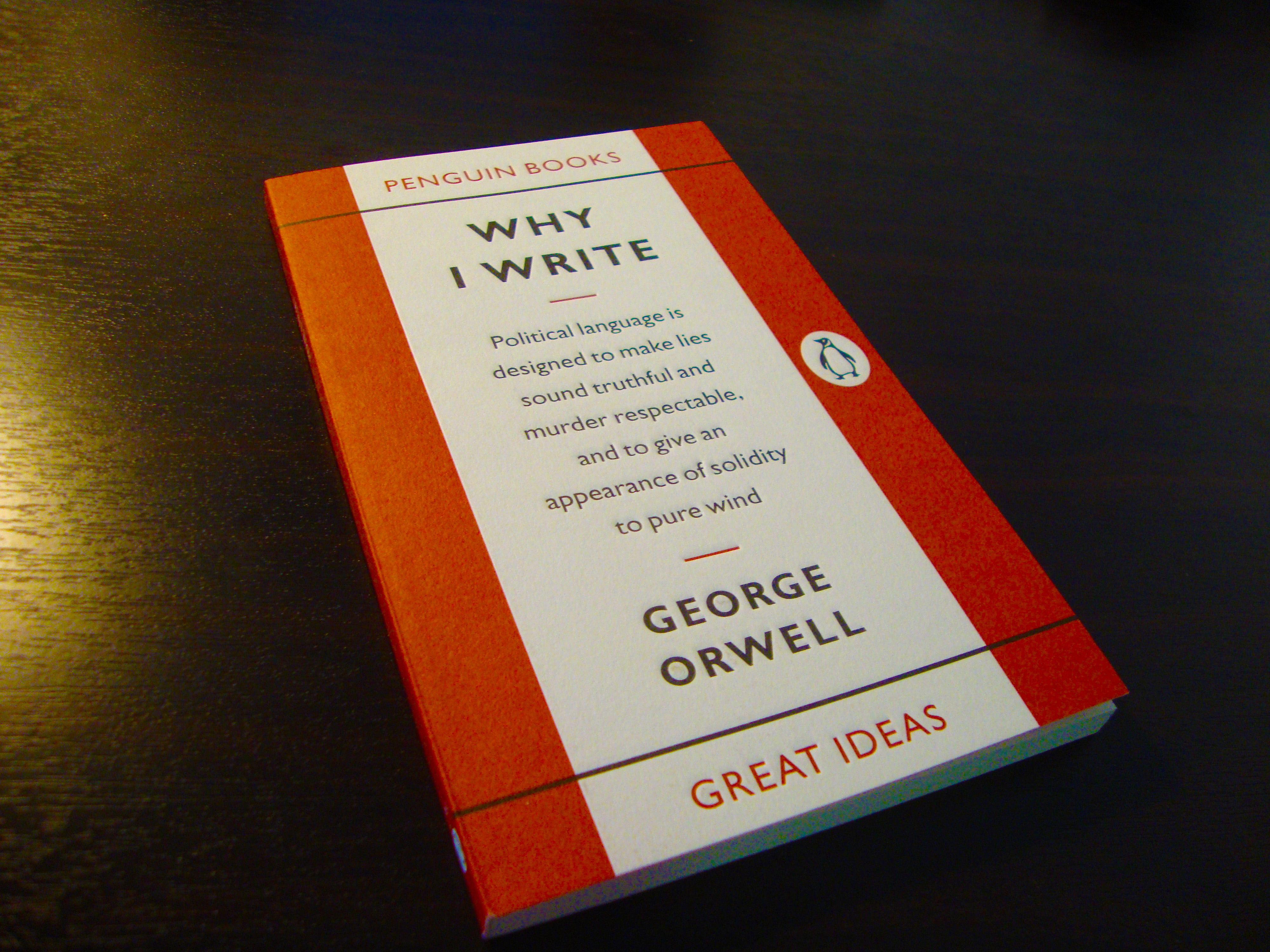
    George Orwell – Why I Write

    From a very early age, perhaps the age of five or six, I knew that when I grew up I should be a writer. Between the ages of about seventeen and twenty-four I tried to abandon this idea, but I did so with the consciousness that I was outraging my true nature and that sooner or later I should have to settle down and write books.

    – George Orwell, Why I Write

    Today I found this copy of a collection of essays by Orwell. He’s one of my most favourite writers. I thoroughly enjoyed Nineteen Eighty-Four,  and these essays, particularly the main one, Why I Write, is sure to give me further insight into this remarkable man’s motives for writing. Perhaps even some inspiration for my own writerly pursuits.


  • Facebook is More Than Just a Website Now

    In what was perhaps the largest initial public offering announcement since the time of Google, Facebook finally announced that it was going public, and launched its portfolio on the NASDAQ yesterday.

    Almost immediately after the announcement, its shares fluctuated quite dramatically. And cue the Internet noise as commenters from esteemed economists to the average blogger started speculating the demise of the social media giant.

    Here’s what I think, though: Facebook has become more than a simple website. It’s more than a mere social network.

    Mark Zuckerberg and his team out in Palo Alto have effectively built a social platform. The company has transcended from being a place to keep updated with friends from around the world, to a digital space that is set to connect not just the world, but the disparate network of websites and blogs that together generate what they call the “social graph.”

    If anything, the future of Facebook looks bright. It has become a tool that we find indispensable on a daily basis, and in some ways offers a sense of connectivity unparalleled by other (more traditional) means of communication. The furthering of the social idea – by “staking a claim” of social space on other websites, and thus creating a more interconnected web – will serve as a bridge, if anything, to what could be termed a “Web 3.0” of sorts.


  • Welcome to Pixelated Thinking, My New Personal Blog

    Blogging has been a big part of my life. Creating websites, the technologies that power the web… these things have fascinated me for a long time. When I discovered this thing called blogging, and the ease with which one could publish on the WWW, and thus stake a claim to a small slice of this ever-expanding digital sphere, I was captivated.

    It’s been around five years now that I’ve been involved in the blogosphere. I’ve created numerous blogs, most of them fairly successful. But one constant that has run along my blogging adventures has been my personal blog, which I named Life in Pixels. It was started in 2007 on WordPress.com. From then, I’ve learned a lot about blogging by testing ideas out on this personal platform. In 2010, I finally realised a dream I had for a long time – to self-host my blog. That meant purchasing disk space, a domain name, and managing a discrete installation of the powerful WordPress blogging software. Life in Pixelshad thus moved to its own little space on the web, distinct of a blog network as such.

    However, times move on, and I’ve decided to return to my roots – to where it all began: here, at WordPress.com. I believe that being part of a larger blogging community will do good for my own blogging, and it will further compel me to blog more often (something I’ve been promising for years now…)

    That’s why, with this post, I’d like to introduce you to the next version of my personal blog. I call it Pixelated Thinking.

    Through this blog, I aim to publish my thoughts on the future, on technology – from the social web to the latest ideas and devices being developed around the world – to opinionated essays on science, engineering and the built environment. I’ll also deliver some short fiction from time to time, whenever I get the inspiration to write as such.

    Recently, I have become deeply interested in the way our cities of the future are being shaped. Through my studies in Architecture, and my interest in design, engineering, science and technology, I have begun to contemplate not only our future amongst the stars, but also, out future as it’s occurring through the spaces that define our global society. Pixelated Thinking will serve as a platform on which I aim to project my musings on these matters, along with those I’ve mentioned above.

    Oh, and if you’re wondering about the tagline to my blog – haud ignota loquor – it translates to “I speak not of unknown things” in Latin. It serves as an encompassing statement of what this blog stands for: that everything I write here, the thoughts I proffer about the future, my opinions, they’re things that may seem fantastical (I’ve been known to have crazy ideas) but I truly believe that we can, with our technology and science, attain such visions with time.

    I invite you to share your opinions in the comments section of each post. I cannot express how much comments on a blog mean to a blogger; they really do inspire us digital writers to persevere with our blogging endeavors and continue to generate content for you, our loyal readers.

    So once again, welcome to my new blog.


  • The Collapse of Moore’s Law and the Future

    The big talk around the interwebs at the moment is the so-called “collapse” of Moore’s Law. This fundamental tenet of modern computing, established by co-founder of Intel Corp Gordon E. Moore at the dawn of the digital era, sort of guided the way we think about the future of technology. However, lately, this idea has been challenged by physicists and digital professionals who say that Moore’s Law cannot, in fact, keep up with the exponential pace of technological advancement. In other words, the future doesn’t rest, as we’d always expected it to be, within the realm of silicon-based microprocessors.

    This is an interesting notion, because after all, as we’ve seen with the rise of social media and the “second coming of the Internet” (Web 2.0), technology actually evolves according to the zeitgeist of contemporary life. It’s almost like an organic thing, something that needed initial human intervention to kick-start it, and then was able to grow as we grew.

    I think the next few years are going to be quite interesting in the technological realm. Whilst I wouldn’t go so far as to start speculating about human-like robot butlers, I think that the parallel advancements in technology and science, with new discoveries in both quantum mechanics and materials engineering will allow for the creation of systems that can truly go beyond the scope of the notion Gordon Moore had of an exponentially-evolving computing landscape.


  • Pale Blue Dot

    This is a sobering rumination by one of my all-time favourite scientists and thinkers, Carl Sagan, about our existence in this universe. It really puts things into perspective… (taken from his sequel to the brilliant Cosmos, “Pale Blue Dot: A Vision of the Human Future in Space.”)

    We succeeded in taking that picture [from deep space], and, if you look at it, you see a dot. That’s here. That’s home. That’s us. On it, everyone you ever heard of, every human being who ever lived, lived out their lives. The aggregate of all our joys and sufferings, thousands of confident religions, ideologies and economic doctrines, every hunter and forager, every hero and coward, every creator and destroyer of civilizations, every king and peasant, every young couple in love, every hopeful child, every mother and father, every inventor and explorer, every teacher of morals, every corrupt politician, every superstar, every supreme leader, every saint and sinner in the history of our species, lived there on a mote of dust, suspended in a sunbeam. The earth is a very small stage in a vast cosmic arena. Think of the rivers of blood spilled by all those generals and emperors so that in glory and in triumph they could become the momentary masters of a fraction of a dot. Think of the endless cruelties visited by the inhabitants of one corner of the dot on scarcely distinguishable inhabitants of some other corner of the dot. How frequent their misunderstandings, how eager they are to kill one another, how fervent their hatreds. Our posturings, our imagined self-importance, the delusion that we have some privileged position in the universe, are challenged by this point of pale light. Our planet is a lonely speck in the great enveloping cosmic dark. In our obscurity – in all this vastness – there is no hint that help will come from elsewhere to save us from ourselves. It is up to us. It’s been said that astronomy is a humbling, and I might add, a character-building experience. To my mind, there is perhaps no better demonstration of the folly of human conceits than this distant image of our tiny world. To me, it underscores our responsibility to deal more kindly and compassionately with one another and to preserve and cherish that pale blue dot, the only home we’ve ever known.

    – Carl Sagan, “Pale Blue Dot: A Vision of the Human Future in Space”